

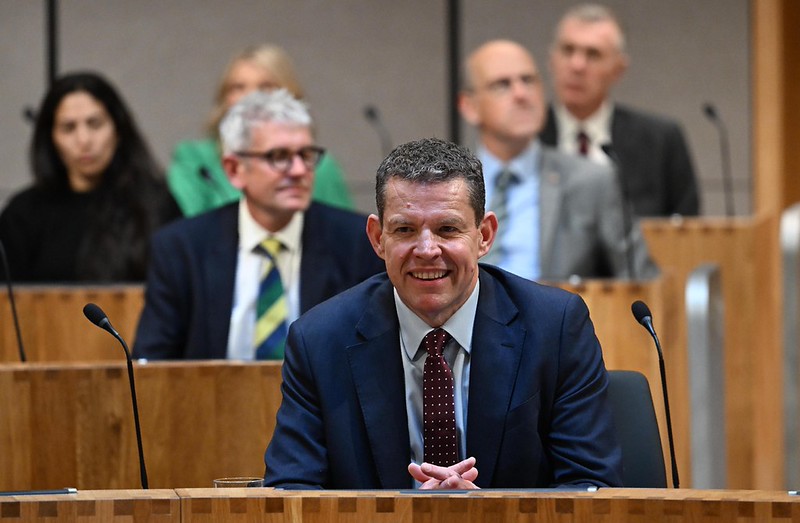
Plaid Cymru leader Rhun ap Iorwerth is Wales’ new First Minister, after securing the backing of Senedd Members in the first Plenary session following the election on May 7.
Mr ap Iorwerth led his party to a historic election victory last week securing 43 seats out of 96.
Despite falling six short of an overall majority, Plaid Cymru will lead the next Welsh Government as a minority administration.
After securing the support of the Green Party, a total of 44 MSs voted to nominate Mr ap Iorwerth as First Minister.
All 34 of Reform UK’s members backed their leader Dan Thomas to be First Minister, and the Welsh Conservatives’ seven members voted for their leader Darren Millar.
Eight Labour members and the Liberal Democrats’ sole member Jane Dodds abstained in the vote.
Llywydd
Earlier in the session, former Deputy First Minister Huw Irranca-Davies took the position of Llywydd – the Senedd’s equivalent of Speaker – with newly elected Plaid Cymru MS, Kerry Ferguson, securing the role as Deputy.
As a result of their selection to the non-political roles, they were unable to take part in the nomination process for First Minister.
Speaking after his election by fellow members, the Senedd rose to its feet and applauded Mr ap Iorwerth who said: “Something has stirred in the soul of Wales – a new confidence, a new hope, a new, broader horizon, never to be narrowed again by the naysayers with other priorities in other places.
“From this historic moment onwards, every person in every part of our nation can know that the Government of Wales is their government. And they will know that their government does not and will not impose on itself, or on our citizens, any limits on what our nation can achieve.
And my promise to everyone is that I will lead without prejudice or presumption. I’ll never take this privilege for granted, nor will my principles be burdened by power, because the challenges we face are too many in number and too grave in nature for us to lose sight of what is at stake.”
With the second largest number of Senedd Members, Reform UK now takes on the role of opposition – a point its leader Mr Thomas was quick to remind people of.
He said: “I wish the government well in its efforts to reduce NHS waiting lists, to improve education results, and in creating the right environment for the economy to grow and for job creation, because Wales badly needs it. And to that end, the Reform group will be a robust opposition.
“We will hold Plaid Cymru to account and we will be a voice of the left-behind communities that have voted for us. And Reform is represented across Wales. We represent all people across all of Wales. We will do all we can to break up the cosy consensus that has presided over 27 years of managed decline in this country.
“And finally, I would like to remind Plaid Cymru that this chamber has a pro-union majority, and Reform will work with all pro-union parties to block taxpayers’ money being spent on an independence commission. The future of a prosperous Wales lies within a successful United Kingdom, and Reform will ensure that that union prevails. The people of Wales have made that clear at the ballot box, and Reform serves the people of Wales. Diolch yn fawr.”
Labour’s new interim leader, Ken Skates, paid tribute to his predecessor and former First Minister Eluned Morgan, who dramatically lost her seat.
A Lord of the Rings fan, Mr Skates made reference to his Labour colleagues and Mr Irranca-Davies’ new role as Llywydd.
“We may only be a group of nine now,” he said. “But above all we are a fellowship, and, let’s remember, in The Fellowship of the Ring it was just nine warriors who overcame enormous odds to bring down an empire, guided by their very own Gandalf, who will now guide us and protect our democracy with his shiny new mace.
“Be assured we will not let the party of Government off the hook at any time, as they, quite rightly, did not allow us to. Within our group we have a combination of immense experience and new energy and expertise, but above all we have passion and purpose.”
EXPLAINER: What is the role of the ‘Llywydd’?
The election of Labour’s Huw Irranca-Davies as Llywydd proved controversial with Welsh Conservative leader Darren Miller accusing Plaid Cymru and Labour of a “stitch-up”.
Paul Davies from the Welsh Conservatives was also put forward for the position by his Conservative colleague, Sam Rowlands, but failed to secure a seconder and his nomination did not stand.
Mr Miller said: “In no other western democracy would a person jump directly from being the former Deputy First Minister or Deputy Prime Minister of their nation into the speaker’s chair in the very next Parliament.
“Frankly, it stinks. The role of the Llywydd demands absolute impartiality. It should not be treated as a consolation prize for the previous Deputy First Minister after their own political party has just been vomited from government in such a spectacular way by the electorate.
“To do so, undermines and damages the reputation of this Parliament, because a Presiding Officer must command respect across the whole of the Senedd, especially amongst opposition parties and those who have a role in scrutinising the government.”
Described on the Senedd Cymru website as the “single most important office in the Senedd”, the role of the Llywydd is similar to the Speaker of the House in Westminster.
They are responsible for chairing Plenary meetings, maintaining order within the Siambr, and chairing the Senedd Commission.
As well as this, they play a central role in representing Wales’ interests on a national, UK, and international stage
The Llywydd is also required to remain politically impartial at all times – despite their association with one of the political groups.
As part of their roles, neither the Llywydd or Deputy Llywydd are permitted to take part in Senedd votes – except where legislation requires votes to be passed by two-thirds of members.
Importantly, either the Llywydd or deputy Llywydd must be from a political group which has an executive role (i.e. in government) and the other must be from a political group which does not have an executive role.
This means if the Llywydd is from a political group in government, the deputy Llywydd must be from a political group which is not in government.
They must also not be from the same political group.
In the secret ballot, the former Deputy First Minister secured 85 votes, with nine against and one abstention and was elected as the Llywydd.
As former Llywydd Elin Jones moved to join her Plaid Cymru colleagues on the bench, Mr Irranca-Davies thanked Ms Jones for her “careful and specialised stewardship” of the Senedd over the past decade.