

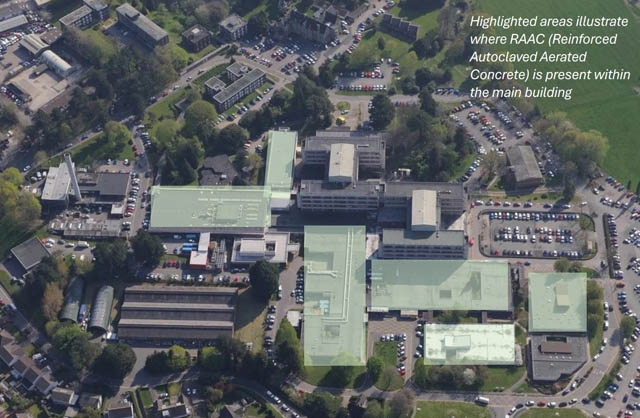
HEALTH chiefs have backed plans that could lead to a £400 million investment in a Gwent hospital plagued by lightweight concrete.
Significant refurbishments are required at Abergavenny’s Nevill Hall Hospital due to the presence of cheap lightweight concrete known as Reinforced Autoclaved Aeriated Concrete or RAAC.
Hundreds of public buildings have been subject to closures or temporary fixes since the UK’s Health and Safety Executive said in 2023 the material was beyond its lifespan and warned it could “collapse with little or no notice”.
The Aneurin Bevan University Health Board has agreed to put forward a Strategic Outline Case to the Welsh Government for an estimated £474.4m investment in Nevill Hall which would reduce the size of the current hospital site and remove the RAAC concrete.
Hannah Evans, the board’s director of planning, said Nevill Hall which has some 200 beds that she described as “pretty much always in use” remains of “strategic importance” to the health board.
She also said the recent opening of the Velindre Cancer Hospital satellite radiotherapy unit at Nevill Hall demonstrated its importance on a regional level as well as services such as outpatient appointments.
Talks have already been held with the Welsh Government over potential investment in Nevill Hall and Ms Chapel said an initial assessment of attempting to remove the RAAC concrete through a “do the minimum” approach had estimated that could cost at least £200m.
She said as many of the affected ceilings have plant machinery on the flat roofs that would also have to be removed and replaced those areas couldn’t operate and the Welsh Government had asked the board to consider further works.
Two further businesses cases will still have to be submitted before a final scheme would be approved but Ms Evans said the strategic outline case will allow the board to access funding and work with a supplier.
Ms Evans described the outline case as a “preferred way forward” for overhauling Nevill Hall and includes a new building to accommodate the services in parts currently impacted by RAAC, refurbishment of the retained H block wards which don’t have RAAC and could also allow for further development including the possible relocation of the Maindiff Court mental health unit.
In response to a question from Blaenau Gwent councillor Helen Cunningham, Ms Evans said she anticipated no decision will be taken until after May’s Senedd election and said the board will continue to manage the affected areas in line with the latest guidance.
Independent board member Paul Deneen said problems with hospital buildings across Wales have been prominent in the news and asked if the board is aware of where Nevill Hall stood as a national priority.
Ms Evans said she doesn’t know how it compares with other projects across Wales but said the Welsh Government has confirmed to the board it considers Nevill Hall and St Woolos Hospital in Newport as the priorities for the board’s requests for investment.
The £474.4m figure is the total anticipated investment required based on current cost assumptions and includes a contingency fund.